

China accelerates. A stronger yuan and 5% GDP growth

The Chinese economy was back on the radar of investors around the world when somewhat disappointing April data were published. The blow fell in particular on the yuan, and the USD/CNY rate rose above 7.0. In our view, China's economy is gaining momentum after a difficult 2022. The central bank is keeping rates low against consistently low inflation. In 2H23 we expect the economy to accelerate and the yuan to strengthen against the dollar and the rouble.
GDP growth in 2023 will be close to 5%. China's GDP growth in 1Q23 reached 4.5% y/y thanks to strong dynamics in services (5.4% y/y). Economic activity in April was below market expectations but nevertheless strong. Industrial output in China rose 5.6% y/y last month against expected growth of 9.7%, while in March the figure was 3.9%. Retail sales in China rose 18.4% y/y in April; an increase of 20.2% had been expected, and growth of 10.6% was recorded in March. Fixed-asset investment added 4.7% (5.1% a month earlier). Meanwhile analysts disagreed about the prospects for China's GDP growth for the whole of 2023. The April data point to a slowdown in the pace of China's recovery, but we are optimistic about its growth prospects in 2H23. Judging by the increase in tourist trips to the country, we believe China is opening up again. This will lead to higher consumer demand in the coming summer months, which will give significant support to world GDP, primarily to the metals and petroleum products markets. China is not hiding the problem of slowing economic growth. The People's Bank may begin to stimulate the economy by cutting the rate, which will increase the money supply to support lending. We expect energy prices to rise and the Russian rouble to strengthen against the yuan in 2H23 on the back of faster economic growth in China. We believe April will be the last month showing weak figures, and demand in China will grow in the coming months. Rating agencies maintain a positive outlook for China's economy; the IMF forecasts GDP growth of 5.2% in 2023. We agree with the consensus forecast and expect GDP growth of 5.0% in 2023.

Source: Pixabay.com
We expect the USD/CNY rate to remain around 7.0 in 2023. As of the end of May it had lost about 3% since the start of the year and was above 7.0. In our view, the weakening of the yuan is temporary and was related to weak (weaker than the consensus forecast) economic growth in April. We believe the recovery of outbound tourism will reverse capital outflows. Another reason for the yuan's weak performance is the growing gap between yields in China and the US. The three-month interbank yuan rate is almost 300 bp below the comparable London interbank offered rate (LIBOR) in US dollars, the largest gap ever observed. Companies are holding dollar deposits to earn higher returns. We maintain a bullish position on CNY/USD in 2H23, believing that the yuan's lag will end as the economic concerns of the first half of the year prove unfounded. In our view, the Chinese currency will strengthen to USD/CNY 6.8-6.9 in the coming months and average 6.8 in 2023.
The CNY/RUB rate will move towards 11.0 in 2H23 and on average in 2023. According to the Bank of Russia, the importance of the currencies of friendly countries, mainly the yuan, continues to grow on the Russian currency market. The yuan's share in settlements for Russian imports and exports has increased to 18% and 27% respectively. On the domestic currency and over-the-counter markets the share of the Chinese currency continues to grow and now stands at 36.1% and 22.3% of trading volume respectively. At the same time, balances in yuan on the correspondent accounts of Russian banks have fallen significantly, so yuan liquidity is becoming more expensive on the domestic market. The trade balance with China remains in deficit. Exports from China to Russia in 1Q23 rose 47.1% to $24.07 billion, and imports from Russia to China rose 32.6% to $29.8 billion. At the same time, retail investors continued to buy yuan in April (net purchases amounted to 54.2 billion roubles). In March significant yuan purchases totalling 41.9 billion roubles were also observed. Overall, the Chinese currency continues to rise against the Russian currency thanks to high demand from market participants. Given our forecasts for the USD/RUB and USD/CNY cross rates, we expect the CNY/RUB rate to move towards 11.0 in 2H23 and on average in 2023.
Inflation in China will remain low. The consumer price index rose by only 0.1% y/y in April (0.7% y/y in March), the slowest pace since February 2021. Food prices rose 0.4% y/y (the lowest pace in 13 months), and non-food goods became 0.1% y/y more expensive in April. Inflation excluding food and energy was 0.7% y/y last month, as in March. Month on month, CPI fell 0.1% in April (-0.3% in March), the third consecutive monthly decline. Meanwhile China's producer price index fell 3.6% y/y in April (-2.5% in March), mainly due to last year's high base for food and energy prices and to lower prices of durable goods to stimulate sales. PPI has been falling for seven months in a row, and in April the decline was the largest since May 2020. Although the economy is recovering after the pandemic, the indicators still point to weak domestic demand: the authorities have room for an economic policy that stimulates a recovery led by the consumer sector. CPI remains well below the government's 3% target for this year. At the same time, the People's Bank of China sees no signs of deflation, as core inflation in China is stable at 0.7%, while services, money supply and lending are growing fast. The Chinese regulator expects CPI to fluctuate in a narrow range at low levels in May-July because of the high base of comparison, to rise slightly in 2H23 and to recover to the average level of recent years by the end of 2023. We forecast that inflation will reach 1.5% y/y in 2023 and remain within 1-2% y/y in 2024.
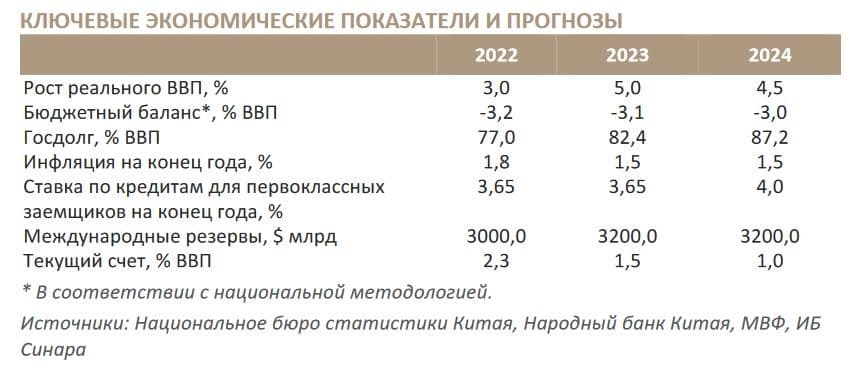
The People's Bank of China keeps its rate unchanged. At its May meeting the regulator left the benchmark rate at 3.65%. The rate on one-year loans issued under the MLF programme was kept at 2.75%. This is the ninth consecutive board meeting to decide to leave it unchanged. The MLF is an important lending instrument used by the People's Bank of China to provide liquidity to commercial banks; it directly affects the benchmark rate (the rate on loans to prime borrowers), which became the benchmark in the summer of 2019. The regulator has so far shown restraint in its support measures. Instead of cutting interest rates this year, it supported lending by lowering the reserve requirement ratio. The stimulus also extended to infrastructure: for example, China's provinces plan to increase spending on major construction projects by almost 20% this year. Low inflation suggests that the People's Bank may have to make more effort to further restore the economy by cutting the rate. On 15 May the regulator published its monetary policy report for 1Q23, noting that the triple pressure on the economy (from shrinking demand, excess supply and lowered expectations) had eased and that economic growth had been better than forecast. The regulator expects positive shifts in consumption, investment and exports in the short term and a gradual recovery in prices. We, however, believe that the key rate will remain at its current level this year, with a small increase in 2024.
The budget deficit remains moderate. On 13 March, at the annual "two sessions" convened by the government, China gave final approval to the new state budget, which will play an important role in shaping the path of development. China's general state budget for this year provides for revenue of CNY23.6 trillion ($3.4 trillion) and expenditure of CNY27.5 trillion ($4 trillion), so the official deficit should be almost CNY3.9 trillion ($564.1 billion), or 3% of GDP. New data on China's state budget for 2022 show that the government received less revenue than forecast.
The debt burden remains significant. At the end of last year China's public debt was $14 trillion, up $1.2 trillion over the year, and its ratio to GDP reached 77.1% (+5.23 pp compared with 71.84% at the end of 2021). Beijing plans to issue sovereign bonds worth CNY3.16 trillion ($458 billion) during 2023, CNY510 billion more than a year earlier. At the same time, the central government deficit, which includes new special obligations issued by local authorities and better reflects the scale of fiscal support, is expected to reach CNY7.68 trillion this year, or ~6% of nominal GDP. According to IMF forecasts, the budget deficit will remain around 3% of GDP in the coming years under the national methodology. Meanwhile the already high levels of sovereign debt worry the IMF, as does its expected further growth. Total gross public debt will rise from 77% of GDP in 2022 to 87% in 2024.
We expect export growth to slow while imports gradually recover. April export figures (+8.5% y/y) were better than forecast. Imports, however, were very disappointing, falling 7.9% y/y. As a result the trade surplus increased from $88.2 billion to $90.2 billion. The external factors that should push the economy towards recovery after the lifting of anti-COVID restrictions are showing up weakly. In April cars remained the main driver of exports, with exports up 195.7% y/y after a rise of 123.8% in March. Preliminary balance of payments estimates for 1Q23 still point to strong values, though slightly below forecasts. The current account surplus was $82 billion (2.0% of GDP). Outflows on the capital and financial accounts slowed compared with 4Q22. As for direct investment, an outflow of $30 billion was recorded in 1Q23, continuing the 4Q22 trend. The IMF forecasts that the current account surplus will persist at the end of this year at 1.4% of GDP, and we agree with this estimate.
Russian-Chinese trade turnover is rising sharply. Trade between Russia and China in 4M23 jumped 41.3% compared with the same period last year to $73.15 billion. These statistics are published by China's customs authorities, according to which Russian exports exceeded Chinese ones ($39.46 billion versus $33.68 billion).